

Performance-based assessment, at scale
Projects.
Verified.
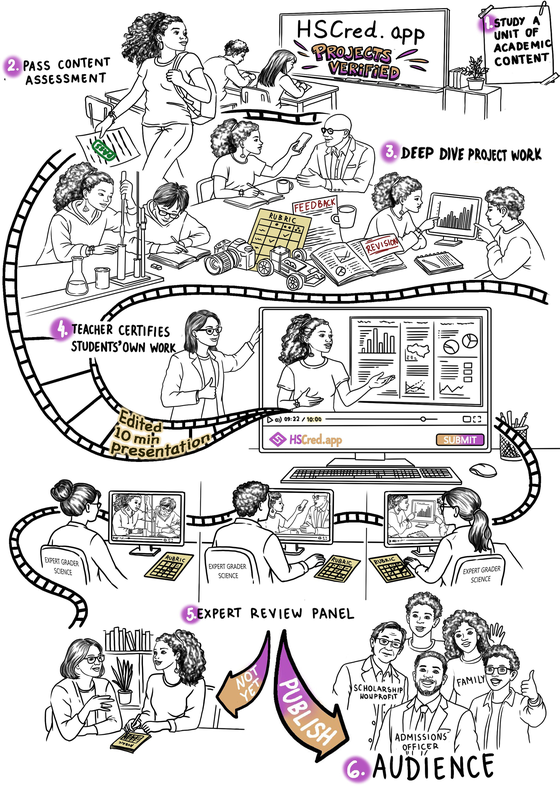
Students make real work and defend it out loud. Three experts score it against one public standard, so colleges can compare work, not test scores.
Scholarships are open now.
Talent is evenly distributed. The proof of it never was. Until now.
Start with your role. Who HSCred is for.
Make something worth showing
Starting fall 2027, a New York diploma can rest on real work instead of one exam in June. The Regents mandate is being phased out for the first time in over 160 years. That window is open right now, and it closes if nobody uses it.
Scholarships · open now
You can start producing today.
You do not need to wait for your school to catch up. Submit your best work as a 10-minute video presentation, and the Academic Capital Foundation can pay your reviewers directly. The full hundred-dollar experience, at no cost to you. It is a scholarship, not a waiting list: strong work earns it, decisions are not explained, and not every submission wins one. If yours does not, your school can issue an access card, or you can pay for the review yourself.
Ten published credentials, maximum. About one every other month, summers off, from late sophomore year through the fall of senior year. Ten is double the five Regents exams New York requires, and enough to cover every subject you take, without burying the professors who review them.
Your rights, starting fall 2027
- 01Make real work, and be judged on it.
- 02Never be judged by a number that cannot be backed by actual work.
- 03Your own voice, your own questions, your own academic culture.
- 04Fail, as long as you are willing to try difficult things.
- 05Have time to use what you learned after the test is over.
- 06An equivalent record no matter which high school you attend.
- 07Coming soon: say no to high-stakes testing whenever you are willing to do a performance-based alternative.
“If students know how it works for college applications, they will all upload their videos to HSCred.”
 A.R.Biology professor · STEM Institute
“HSCred is a creative space. You can let your creativity run freely.”
 K.K.Student · 11th grade
“The app was very easy to navigate. You read it and you know what they are asking from us: what part of my project needs support, and what part has to go away to make it look better.”
 R.T.Student · 11th grade
“HSCred gives me an opportunity to go beyond. I have spent years learning how to get the right answers. Now I want to ask questions no one else is asking.”
 A.P.Student
“The normal test doesn’t define who you are as a person. I am very much bigger than all of the tests I have ever taken in my life.”
 Z.Student
“Through HSCred, I hope to share my research and show the impact of student work beyond the classroom.”
 C.H.Student
“Publishing on HSCred would not only let me show my work, but show my dedication and passion for it.”
 A. I.Student · Living Systems
“Standardized testing doesn’t show what students can create. Memorizing flashcards doesn’t prove capability. Execution does.”
 Y.A.Student · App Development
“My curiosity doesn’t end when class does. A transcript shows where I’ve been. Curiosity shows where I can go.”
 D.Z.Student · App Development
“Every student has a transcript, but not everyone can tell a story through their grades.”
 S.M.Student · Living Systems
“I’m ready for my work to reach an actual audience, not to be graded and then forgotten.”
 R.Y.Student · Living Systems
Teach to the work, not the test.
You already vouch for students. A recommendation letter is your word that a student is more than a transcript. This puts your word on the work itself: a real project, made in your class, good enough to show a college.
Your part
- 01The best student work deserves an invitation to publish. Celebrate college-level work, and let colleges see it too.
- 02The work itself can be a research paper, an experiment, a build. The student's job is to present and defend it on video, showing their thinking the way they would at a science fair or a live defense. Only this time they can edit, and put their best foot forward on their own terms.
- 03Getting rid of the test does not get rid of the proctor: someone still ensures fairness and authenticity. Because you watched the project revisions happen, you can certify the work is this student's own: not a cousin's from five years back, not AI.
Your standing on HSCred
Your score never decides a student's grade. Only the expert panel does that. But when your scores track the panel's, it shows you judge work fairly and accurately. That is what puts you in line to grade on the paid panel when a channel needs it. One thing builds your standing here: accuracy.
Read on: “The Last Banker in Our Classrooms.”
Will your child use AI, or will AI use your child?
Creator
Project-based learning: students create. AI serves them.
Scroller
Test prep: students regurgitate. AI uses them.
From the blog
By spring she is two grade levels ahead and everyone is proud. And she has never made a single thing.
A tutor that cannot struggle cannot teach struggle.
Everything Freire begged us to stop doing during the lesson, we resume the second the lesson ends.
We changed how children learn and left untouched how we judge them.
You already do this for journals.
You review for journals already. A channel is the same work, pointed at high-school students. You open it, approve the rubric, and pick the experts who grade. Three score each upload. Take a seat yourself if you want. Your department is paid for assessment you are qualified to do.
The mission case
Your field needs a stage for the next generation.
Students are already producing sophisticated original work that no admissions officer will ever see. A channel is the stage. You decide the standard, you decide what earns publication, and the students who need it most finally have something to opt into.
The income case
$39,000 a year. One hour a day.
No projection. Just multiplication. Run the channel and take a grading seat too, and every upload pays $50. That is $78,000.
$25 an upload. A review runs ten minutes. Six an hour, one hour a day, fifty-two weeks.
Name your field, publish your criteria, start reviewing. One thirty-minute Zoom from here to a channel with your name on it.
Compare any two applicants by the work.
Every credential arrives already scored: three independent experts, one public standard, applied the same way to a student in Brooklyn and a student in Osaka. You are not adding to the reading pile. You are adding a column you can sort.
A short form. You'll hear back from a person within one business day.
The institutions who reward students are the only side we charge.
Colleges, districts, scholarship funds, and nonprofits all need the same thing: a way to find the students already doing real, project-based work. Students publish it; you discover them.
Today that access is free. A paywall arrives only once publishing reaches scale, and institutions who join now get the full pipeline for nothing, plus a hand in shaping what it becomes.
- 01
Apples to apples, finally
A GPA is not comparable across 27,000 high schools. A credential is. Same rubric, same standard, same evidence trail, whichever school the student attends.
- 02
Pre-vetted before it reaches you
A licensed pedagogue validates the work as original. Three independent experts, appointed by a university professor, score it against the published criteria. Nothing arrives in your queue unread.
- 03
Your algorithm, your call
We do not rank students for you. You get structured, comparable data and you decide what to weight: watch every video, or sort on the scores and never open one. The judgment stays inside your office.
- 04
Nothing to install
No integration, no setup cost, no vendor in your workflow. Every credential is a link out to the student's actual thinking; your readers click through only when they want to.
- 05
Find the ones you were going to miss
The applicant from a school with no AP track, no research program, and a transcript that flattens every strong student into the same B+. The work was the only place that student was ever going to be visible to you. Now it is in front of you, scored the same way as everyone else's.